
Amid the current geopolitical tensions, a new study warns that a long-term blockade of the Strait of Hormuz, a crucial oil shipping route, could severely disrupt global supply chains and destabilize energy markets, potentially leading to far-reaching economic impacts.
A prolonged closure of the Strait of Hormuz, one of the world’s most important oil shipping routes, could put significant pressure on global supply chains and energy markets, according to a new study conducted by the Supply Chain Intelligence Institute Austria (ASCII) in collaboration with the Complexity Science Hub (CSH) and TU Delft.
The analysis shows that exports worth up to USD 1.2 trillion per year could be affected if the strategic maritime passage were blocked for an extended period. The study focuses on five Gulf countries—Iran, the United Arab Emirates, Qatar, Kuwait, and Bahrain—whose maritime exports depend entirely on shipping through the Strait of Hormuz.
Energy commodities such as crude oil, liquefied natural gas (LNG), and refined petroleum products account for roughly USD 800 billion of the affected trade flows.
“The Strait of Hormuz is one of the most critical chokepoints of the global economy. A prolonged blockade would not only disrupt energy markets but could also place substantial strain on global supply chains,” said Peter Klimek, lead author of the study and researcher, director of ASCII and senior researcher the Complexity Science Hub.
Limiting the disruption duration is key
Using the maritime simulation model TIDES, researchers analyzed multiple disruption scenarios involving 10,000 tankers and 1,315 ports worldwide.
Short disruptions of up to two weeks would likely have only limited economic consequences. However, disruptions lasting more than four weeks could trigger cascading delays across global shipping networks. In a simulated 56-day blockade, delays in tanker traffic intensify significantly due to missed port slots, port congestion, and rescheduled shipping routes.
Researchers expect price increases and market volatility in the short term rather than immediate supply shortages, as strategic reserves, inventories, and alternative suppliers could initially buffer disruptions. Longer disruptions, however, could lead to persistently higher energy prices, rising production costs, and reduced competitiveness in energy-intensive industries.
“The longer a disruption lasts, the stronger the chain reactions in global supply networks become, and economic impacts increase disproportionately,” said Stefan Thurner, president of the Complexity Science Hub and co-author of the study.
Asian economies most exposed
Large Asian economies are particularly dependent on exports from the Gulf region. Annual imports from the five Hormuz-dependent exporters include approximately USD 97 billion for China, USD 74 billion for India, and USD 63 billion for Japan, largely consisting of crude oil, LNG, and petroleum products.
The region is also important for other commodities. Between 2019 and 2023, about 31% of global urea exports originated from Gulf countries, while the five states analyzed account for 8–10% of global fertilizer production. They also export specialty gases used in semiconductor manufacturing, including neon, helium, and argon.
Europe unevenly exposed
Within Europe, exposure to Hormuz-dependent trade varies significantly by country. Italy is the largest EU importer from the five Gulf states at about USD 9.8 billion annually, followed by Belgium, which imports around USD 5.8 billion in Qatari LNG, primarily via the Zeebrugge LNG terminal. The United Kingdom shows the highest overall exposure in Europe, with imports worth about USD 12.9 billion annually, including major gas supplies from Qatar. In contrast, Germany and France have more diversified energy import structures.
Call for de-escalation and preparedness
The study concludes that rapid geopolitical de-escalation would be critical to avoid prolonged disruptions. At the same time, policymakers should prepare contingency plans for longer interruptions and ensure transparent communication to prevent market panic and speculative reactions. “Short disruptions can usually be managed. The real risk arises if a blockade lasts long enough for delays to cascade through global supply chains,” Klimek said. “This makes early preparation and clear communication essential.”
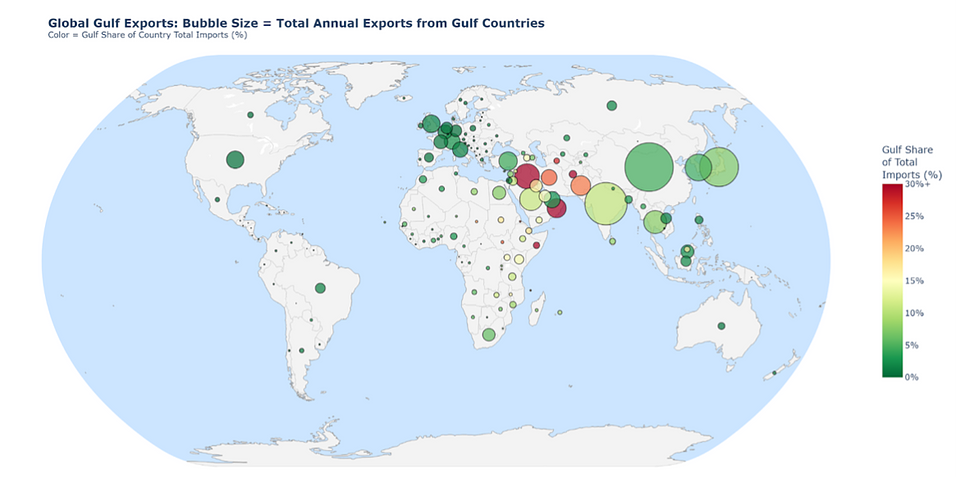
Figure 1: Global trade dependencies on Hormuz-dependent Gulf exporters (Iran, UAE, Qatar, Kuwait, Bahrain). Bubble size represents total trade value; color indicates share from gulf.
About the Study
The study “When the Strait Closes: Trade Dependencies and Shipping Disruption Scenarios for the Strait of Hormuz” analyzes global trade dependencies on exports from five Gulf states and the potential consequences of a blockade of the Strait of Hormuz for international shipping. The analysis is based on international trade data from 2022–2023 and simulations using the TIDES maritime transport model, which represents global tanker traffic with about 10,000 ships and 1,315 ports. This is the first systematic study examining how different blockade scenarios could affect global supply chains and energy trade.
About the Complexity Science Hub
The Complexity Science Hub (CSH) is Europe’s research center for the study of complex systems. We derive meaning from data from a range of disciplines – economics, medicine, ecology, and the social sciences – as a basis for actionable solutions for a better world. CSH members are Austrian Institute of Technology (AIT), BOKU University, Central European University (CEU), Graz University of Technology, Interdisciplinary Transformation University Austria (IT:U), Medical University of Vienna, TU Wien, University of Continuing Education Krems, Vetmeduni Vienna, Vienna University of Economics and Business, and Austrian Economic Chambers (WKO). csh.ac.at
About the Supply Chain Intelligence Institute Austria
The Supply Chain Intelligence Institute Austria (ASCII) is an independent, globally leading supply chain institute for interdisciplinary, data-driven analysis of global production and logistics networks. Its goal is to develop resilient, sustainable, and future-ready supply chains.The institute was founded as a research joint venture by Austrian Institute of Economic Research (WIFO), Complexity Science Hub (CSH), Logistikum of the University of Applied Sciences Upper Austria, and Association Netzwerk Logistik (VNL). ascii.ac.at