Generative AI is reshaping software development – and fast. A new study published in Science shows that AI-assisted coding is spreading rapidly, though unevenly: in the U.S., the share of new code relying on AI rose from 5% in 2022 to 29% in early 2025, compared with just 12% in China. AI usage is highest among less experienced programmers, but productivity gains go to seasoned developers.
REGIONAL GAPS ARE LARGE
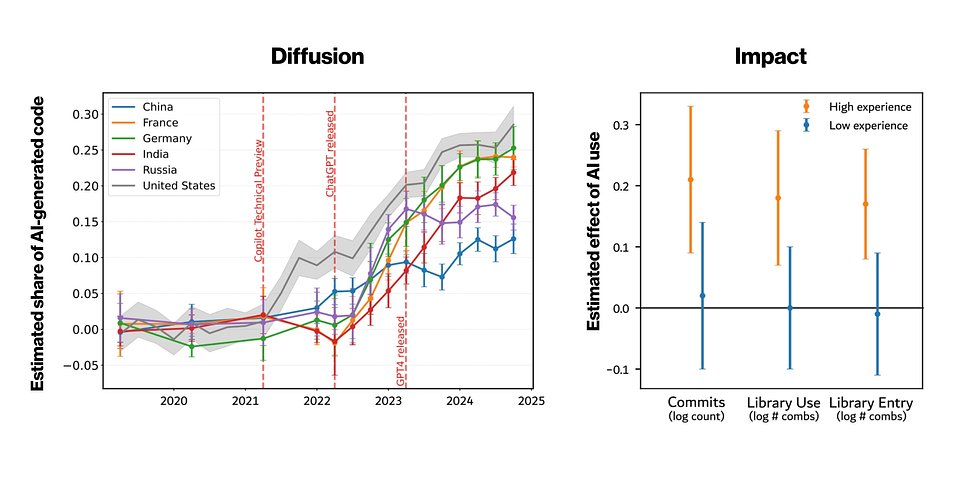
Global diffusion of AI-assisted coding and its impact | Left: The share of AI-written Python functions (2019-2024) grows rapidly, but countries differ in their adoption rates. The U.S. leads the early adoption of generative AI, followed by European nations such as France and Germany. From 2023 onward, India rapidly catches up, whereas adoption in China and Russia progresses more slowly. Right: Comparing usage rates for the same programmers at different points in time, generative AI adoption is associated with increased productivity (commits), breadth of functionality (library use) and exploration of new functionality (library entry), but only for senior developers, while early-career developers do not derive any statistically significant benefits from using generative AI.
EXPERIENCED DEVELOPERS BENEFIT MOST
ECONOMIC GAINS
LOOKING AHEAD
SERVICE