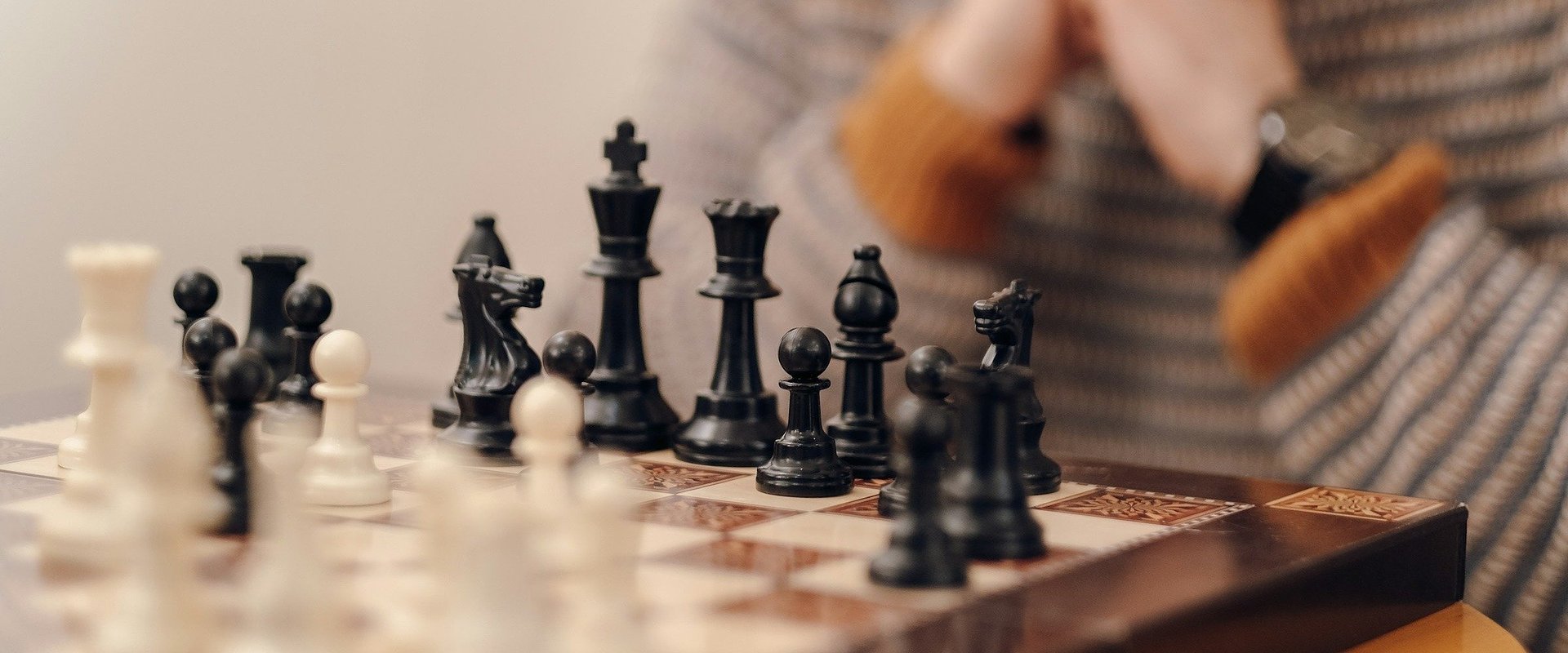
A new study by researchers at the Complexity Science Hub (CSH) finds that chess engines maintain strategic tension significantly longer than the world's best grandmasters.
For decades, chess has served as a laboratory for studying intelligence and decision-making. It is well established that today's chess engines can outperform even the strongest grandmasters. But far less is understood about how their play actually differs.
By analyzing move-by-move interactions in over 2,000 human vs. human and AI vs. AI chess games, a team of researchers from the Complexity Science Hub and the University of Parma found a fundamental difference in how humans and AI handle what they call strategic tension.
"People and AI do not simply differ in how strongly they play," says study author and CSH senior scientist Vito D. P. Servedio. "They differ in how they manage complexity. Human players quickly reduce it. AI is able to sustain it."
The researchers measured this difference by quantifying how many possibilities remain open after each move. The wider the range of possibilities still open at any given point, the greater the “strategic tension” players experience.
At the beginning of a chess game, strategic tension is low. The pieces are still largely disconnected, and the consequences of individual moves are relatively limited. As the game unfolds, each move reshapes the network of possible moves, creating increasingly complex arrangements.
IN THE MIDDLE GAME, HUMANS AND AI PART WAYS
The researchers found that both human and AI players build up strategic tension during the opening and early middlegame. In fact, the best human players briefly reach an even higher peak of tension than engines.
After that, however, their paths diverge: while grandmasters typically begin exchanging pieces and simplifying positions once they leave the deeply studied opening lines that top players prepare and memorize before a game, state-of-the-art engines such as Stockfish and Leela Chess Zero maintain highly interconnected positions for many more moves. Put differently: humans let that tension go, whereas engines keep a broader, board-wide complexity alive far longer.
BETTER PLAYERS SUSTAIN TENSION LONGER
The study, published in APS Open Science, also shows that the ability to sustain strategic tension increases with playing strength. Stronger human players maintain complex positions longer than weaker players, and classical games – with more thinking time – show significantly higher cumulative tension than rapid or blitz games.
A similar pattern appears in artificial intelligence. Increasing the search depth of Stockfish also increases the amount of strategic tension maintained throughout the game, suggesting that sustained complexity is closely linked to computational resources.
"Our results suggest that maintaining complexity is itself a strategic resource," says Servedio. "A powerful AI can keep many possibilities alive simultaneously, whereas humans often simplify positions because managing all those interactions becomes cognitively demanding."
OUTCOME SETTLED BEFORE TENSION PEAKS
Interestingly, the researchers found that the eventual outcome of a game is often determined before strategic tension reaches its maximum. Once one side has established a lasting advantage, both humans and AI generally simplify the position – but AI still carries far more complexity into that phase than humans do.
BEYOND CHESS: LESSONS FOR HIGH-STAKES DECISIONS
Because chess is one of the best-understood examples of strategic decision-making, the authors believe the findings could inform research beyond board games.
“Many of the world's hardest decisions – in diplomacy, military planning or financial markets – share one defining feature: they involve navigating a huge, ever-changing web of possibilities,” Servedio says. Every move creates new opportunities, closes others, and changes the risks for everyone involved. The larger this web of possibilities becomes, the more demanding the strategic challenge becomes.
"Chess gives us a controlled environment for studying how intelligent systems balance immediate opportunities with long-term consequences," says former CSH postdoctoral researcher Eddie Lee, now Assistant Professor in Physics & Astronomy at Seoul National University. "If AI augments complexity here, what about other strategic settings? The risk of introducing a complexity-embracing player has unknown ramifications for negotiations, economic competition, and conflict."
The authors caution that real-world situations are far more uncertain than chess and that direct comparisons should be made carefully. Nevertheless, the work highlights a fundamental difference between biological and artificial intelligence: superior computation does not merely produce better decisions – it also changes how complexity itself is handled.
Service
ABOUT THE STUDY
The study “AI sustains higher strategic tension than humans in chess” by A. Cerioli, E. D. Lee and V. D. P. Servedio is tentatively scheduled for publication in the journal APS Open Science on September 4, 2026, though the date remains subject to unforeseen changes.
It will be available here once published: https://doi.org/10.1103/63cv-52fj. Until then, it is listed here: https://journals.aps.org/apsos/accepted/10.1103/63cv-52fj.
It will be available here once published: https://doi.org/10.1103/63cv-52fj. Until then, it is listed here: https://journals.aps.org/apsos/accepted/10.1103/63cv-52fj.
The paper is not under embargo.
ABOUT THE COMPLEXITY SCIENCE HUB
The Complexity Science Hub (CSH) is Europe's research center for the study of complex systems. Drawing on large-scale data across economics, medicine, ecology, and the social sciences, CSH develops quantitative methods to understand the interconnected networks that underlie society – from financial markets and supply chains to public health and urban development. The goal is to provide a rigorous basis for navigating the challenges of an increasingly complex world.
Members of the Complexity Science Hub are: AIT Austrian Institute of Technology, BOKU University, Central European University (CEU), IT:U Interdisciplinary Transformation University Austria, Medical University Vienna, TU Wien, TU Graz, University for Continuing Education Krems, Vetmeduni, WU Vienna and WKO.
csh.ac.at
Members of the Complexity Science Hub are: AIT Austrian Institute of Technology, BOKU University, Central European University (CEU), IT:U Interdisciplinary Transformation University Austria, Medical University Vienna, TU Wien, TU Graz, University for Continuing Education Krems, Vetmeduni, WU Vienna and WKO.
csh.ac.at