During the Second Industrial Revolution, new technologies both destroyed and created jobs. We know little about how the workforce shifted out of old jobs and into new ones. This is what Hillary Vipond from the Complexity Science Hub (CSH) examined in her study of a technological shock in 19th-century England, offering lessons for how to think about jobs in the age of AI.
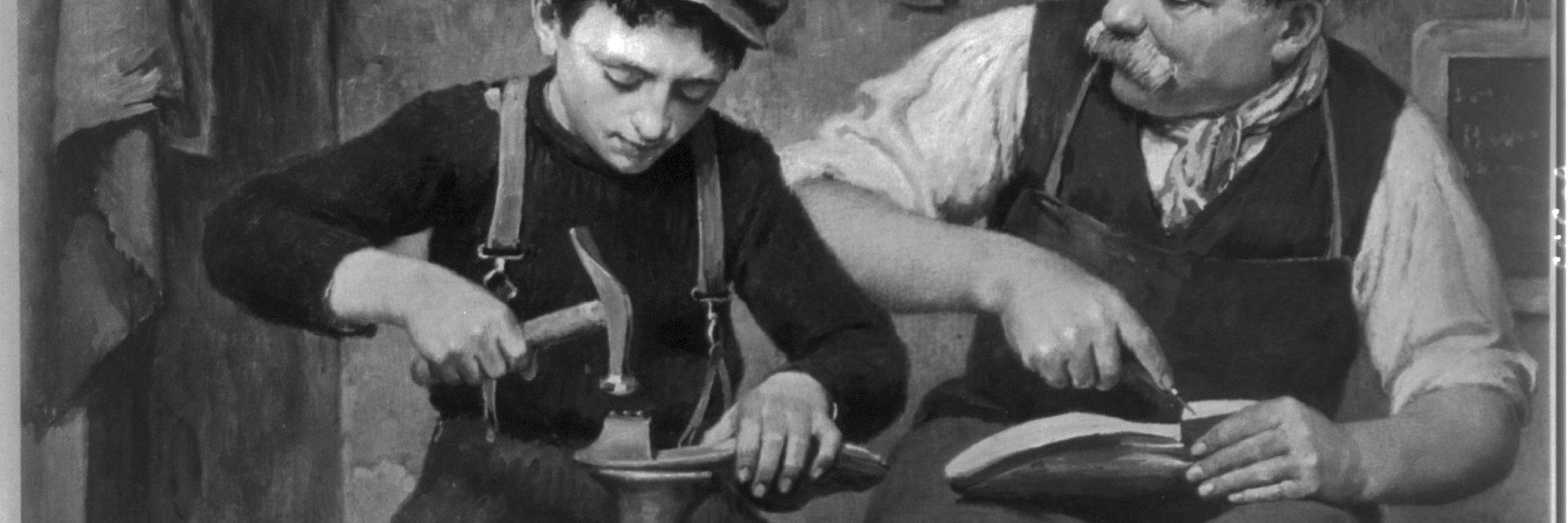
Put yourself in the shoes of a bootmaker in 19th century England. Bootmaking was a sophisticated craft trade that involved cutting, stitching, and sewing leather. It required skill, experience, and time.
It was also one of England’s leading industries: by 1851, the country was home to about 220,000 bootmakers. Mechanization was brought about by the innovation of sewing machines which were able to work heavy boot leather, and they were rapidly adopted. This boosted productivity – workers could produce four to eight times more boots in the same timeframe ‒ and it forever transformed the industry. By 1911, two thirds of artisanal bootmakers had disappeared.
Job destruction, however, is only half of this story, says Hillary Vipond, economic historian and postdoctoral fellow at the Complexity Science Hub (CSH). “Historically, new technologies have also created jobs, but we know very little about that side of the coin.”
Drawing on English census records from 1851 to 1911, Vipond quantified both job loss and creation as the bootmaking industry mechanized, from onset to completion. The economic historian discovered a relatively small net loss of jobs, and existing bootmakers did not face labor displacement. “To my surprise, they were not pushed out of their jobs, nor did they move to places where new opportunities emerged.” Instead, their trade disappeared over time as the younger generation refrained from entering it.
New jobs emerged, but only in few places
Vipond found that 153,000 traditional bootmaking jobs were rendered obsolete as the industry mechanized. In the same period, 140,000 new roles were created, for example in machine operation, sales, management, administration, and more specialized tasks which became part of the new production process.
However, those new jobs were not equally available to everyone. As the industry shifted to factory work, the new jobs increasingly concentrated in the places where large factories were built. “44% of the new jobs emerged in just two counties: Northamptonshire and Leicestershire,” Vipond reports. The new jobs also primarily went to young workers.
Adaptation shouldered by younger cohorts
The economic historian next asked how workers navigated these changes. Tracking individual job-level trajectories, and seeing that incumbent artisanal workers were for the most part neither pushed out of their jobs, nor migrated from their place of residence to seek factory work, she was left with a puzzling question. Vipond asked: "How could so many jobs be lost when most incumbent artisanal workers didn’t have to leave their trade?”
Vipond found the answer among the younger age cohorts: “Young people stopped entering the dying artisanal industry. I saw a massive collapse in entry within these cohorts.”
This means that most of the job market changes, both on the destruction and creation side, were shouldered by young people. New jobs were taken up by them, albeit overwhelmingly by those born in the counties where the new work emerged. Access to the new jobs was therefore highly unequal.
Demand for older skills persisted, but not for the work of female bootmakers
Why were incumbent artisanal bootmakers not immediately made obsolete by the new sewing machines? “Mechanization actually did not fully replace the original product”, says Vipond. Factory-made boots were cheap, but there was still demand for high-quality handmade artisanal boots. “They were a premium product that well-off demographics were still willing to buy”, says Vipond. “And this meant the artisanal trade persisted. The data reveal a clear overrepresentation of traditional bootmakers in wealthier places.”
While incumbent workers overall did not face substantial labor displacement, there were stark gender-specific differences. Most of the female workers in the industry were “binders” who sewed leather pieces together by hand. The new machines replaced them altogether. Nearly the same number of new jobs for women were created, but these went to young women in Northamptonshire and Leicestershire. Men, in contrast, had broader task variability and skills that were still in demand.
What can we learn from history?
Over the last three centuries, new technologies have made millions of jobs obsolete, and they have disappeared. However, new jobs, demanding new skills, have emerged. “Approximately 60 percent of all job titles in the US today did not exist in 1940, according to researcher from MIT: it is the creation of new jobs which has kept people employed,” says Vipond.
Vipond’s study of bootmaking in Victorian England examines how the workforce transitioned away from an occupation sent into decline by new technology. In this case, the transition operated primarily through young people. Incumbents largely kept their jobs. For young workers, opportunities in the artisanal bootmaking industry disappeared, but new ones emerged in the more mechanized production process.
What can we learn from history for today’s AI age? “The impact on workers, their families, and regions will not only be a matter of how many jobs are lost to generative AI. How many jobs are created, and where, will be at least as important”, says Vipond. “What is different this time, is that, although new jobs will emerge as generative AI is adopted, there is an open question as to whether it will be humans who take them”, says the economic historian. “For the first time in human history there is a possibility that machines will almost immediately outcompete human labor for the new types of work.”
Who bears the cost of the transition also depends on how quickly new technology is adopted, highlights Vipond. Historically, new technologies have often been adopted very gradually. The steam engine took decades to replace the watermills in England, and steamships took decades to replace sail. When adoption is slow and demand for older skills persists, obsolescence can be through an aging workforce, with young workers not replenishing the contracting occupation. In this case, it will be young workers who rely on the emergence of new jobs.
However, the adoption of some new technologies has been fairly abrupt. For instance, in the 1920s, when telephone operation was switched over from manual to machine, it made the operators superfluous almost immediately. When this is the case, it is incumbents who are pushed out of work, and must find new jobs.
Knowing how rapidly generative AI technologies will be adopted could help us better understand which generation will bear the costs of the transition. “AI adoption is not straightforward, and we have evidence that it is taking some time”, says Vipond. “Still, the pace is likely to be much faster than it was in the 19th century.”
Service
ABOUT THE STUDY
Find the study “Technological Unemployment in Victorian Britain: Young Workers and the Collapse of Entry” by Hillary Vipond here. It was published as part of SSRN Working Paper Series. Hillary presented the findings at the 2026 NBER SI Labor Studies conference.
View a visual summary of the findings on Hillary Vipond’s website.
View a visual summary of the findings on Hillary Vipond’s website.
ABOUT THE COMPLEXITY SCIENCE
The Complexity Science Hub (CSH) is Europe's research center for the study of complex systems. Drawing on large-scale data across economics, medicine, ecology, and the social sciences, CSH develops quantitative methods to understand the interconnected networks that underlie society – from financial markets and supply chains to public health and urban development. The goal is to provide a rigorous basis for navigating the challenges of an increasingly complex world.
Members of the Complexity Science Hub are: AIT Austrian Institute of Technology, BOKU University, Central European University (CEU), IT:U Interdisciplinary Transformation University Austria, Medical University Vienna, TU Wien, TU Graz, University for Continuing Education Krems, Vetmeduni, WU Vienna and WKO.
Members of the Complexity Science Hub are: AIT Austrian Institute of Technology, BOKU University, Central European University (CEU), IT:U Interdisciplinary Transformation University Austria, Medical University Vienna, TU Wien, TU Graz, University for Continuing Education Krems, Vetmeduni, WU Vienna and WKO.