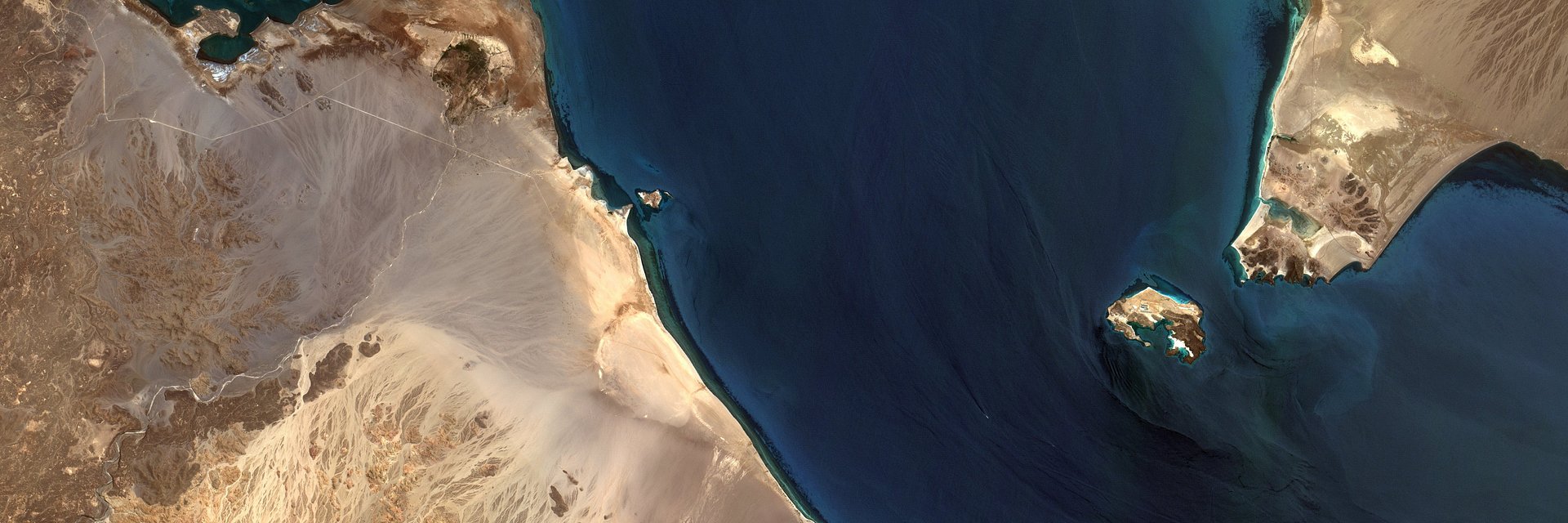
Researchers from the Complexity Science Hub (CSH) and Supply Chain Intelligence Institute Austria (ASCII) estimate that Red Sea disruptions cost the global economy nearly three-quarters of a billion dollars a week. Further escalation could add to the losses, but much of the impact has already been absorbed through rerouting.
Houthi attacks on commercial vessels have disrupted shipping through the Bab el-Mandeb Strait since late 2023, prompting many shipping companies to reroute vessels around the Cape of Good Hope. Recent developments in Yemen have raised concerns about further disruptions in the Bab el-Mandeb Strait, a vital shipping route that connects the Red Sea to the Gulf of Aden and provides access to the Suez Canal. Researchers from the Complexity Science Hub (CSH), the Supply Chain Intelligence Institute Austria (ASCII), and TU Delft developed an agent-based model of global shipping activity to estimate the economic impact of these disruptions. They also estimated the losses in scenarios of increased Houthi hostility.
The team published their findings in the policy brief “Economic impact of reduced shipping due to recent developments in the Middle East”.
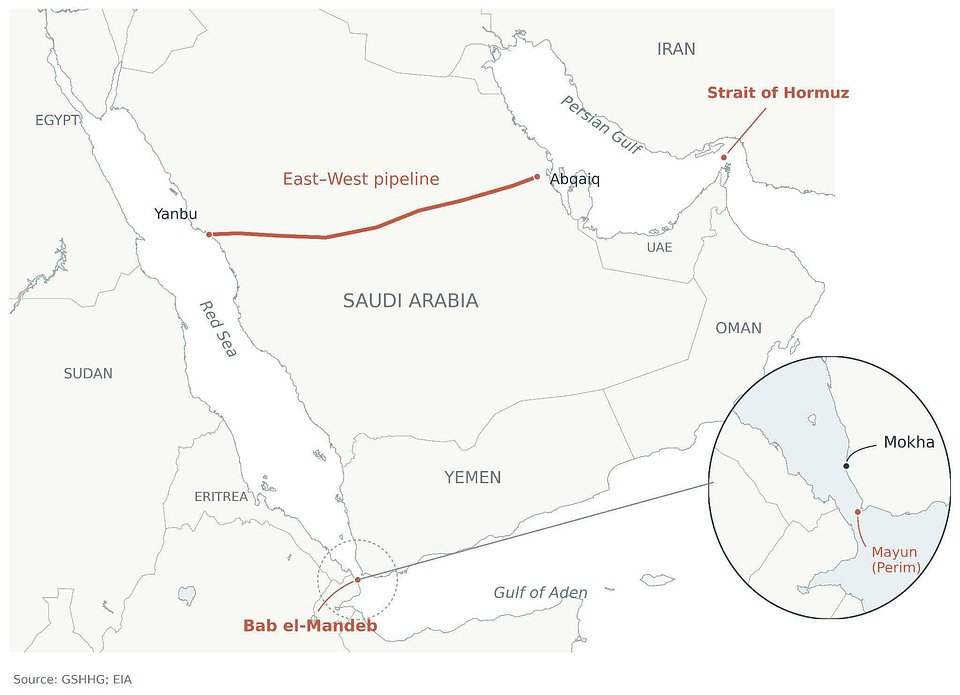
Geographic position of Mayun, Bab el-Mandeb and the route of the East-West pipeline.
GLOBAL WEEKLY LOSSES OF USD 170 MILLION
The researchers estimate a global loss of USD 710 million per week, equating to a 55% decline in shipping volume through Bab el-Mandeb compared to 2023. Higher insurance premiums make passage through the Red Sea more expensive, prompting more ships to reroute around the Cape of Good Hope. The longer routes increase shipping times, while delays accumulate as disruptions propagate through the global shipping network. Backlog losses, which are the costs associated with delayed imports, are therefore by far the largest contributor to the overall economic impact.
ADDITIONAL LOSSES THROUGH FURTHER ESCALATION WITHOUT A FULL BLOCKADE ARE COMPARATIVELY SMALL
The researchers also estimated losses if the situation further escalates, resulting in a renewed wave of Houthi attacks which reduce shipping by another 20%. In this scenario, global economic losses would increase by an estimated USD 310 million per week on top of the current USD 710 million. “The additional losses would be smaller than those caused by the disruption so far because much of the adjustment has already taken place: many vessels have rerouted in response to security risks and higher insurance premiums,” explains Mitja Devetak, CSH PhD student and co-author of the policy brief. To put the burden of a weekly USD 310 million into perspective: if sustained for a year, these additional losses would be equivalent to 0.013% of global GDP.
The economic impact would also take time to materialize. The researchers estimate that losses become visible around six to eight weeks after a disruption begins, reflecting the time it takes for shipping delays to propagate through global supply chains.
In the event of a full blockade of the Bab el-Mandeb Strait (a 100% decline in shipping volume), the costs are significantly higher. The researchers considered a four-week blockade scenario and simulated the total economic cost of all ships having to reroute. At their peak, total losses for the global economy could amount to a weekly USD 2 billion.
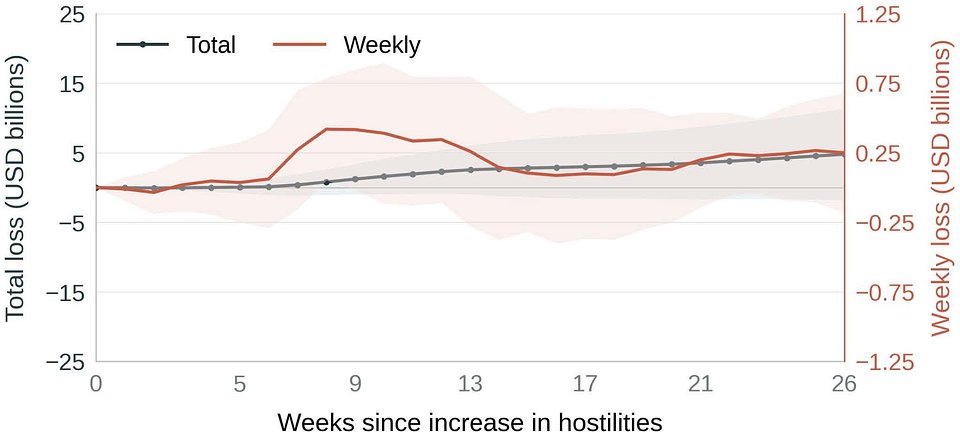
Modeled additional global economic losses from increased Houthi activity, estimated using the shipping model TIDES, relative to the existing shipping disruption. The red line shows weekly losses (right axis), while the black line shows cumulative losses from the onset of potential escalation (left axis). Both include cargo delays, higher insurance premiums, and additional operating costs. Note the different axis scales.
ASIAN ECONOMIES AND EUROPE-ASIA TRADE MOST AFFECTED
Both current disruptions and further escalation are expected to affect Asian economies and European importers particularly strongly. Losses are concentrated in Europe–Asia trade and Middle Eastern exports, particularly in raw materials, petroleum, and manufacturing.
· Current weekly losses are estimated at USD 110 million in the EU and USD 171 million in China. A renewed wave of Houthi attacks would add another estimated USD 83 million weekly losses in the EU and USD 57 million in China.
· Current weekly losses for imports of raw materials and petroleum-related products are estimated at USD 67 million in the EU and USD 151 million in China. Further escalation would add USD 15 million per week in the EU and USD 33 million in China.
“Our model shows that the economic impact goes beyond energy trade, affecting a wider range of industry sectors”, says co-author Peter Klimek, CSH faculty member and ASCII director. “In the short term, these weekly losses remain manageable, demonstrating the remarkable resilience of global supply chains and their capacity to adapt to persistent turbulence. However, if such disruptions persist and compound over time, even seemingly minor losses can accumulate into substantial economic headwinds.”
ABOUT THE POLICY BRIEF
The policy brief “Exposure of Austrian Oil Supplies and Potential Consequences in Three Crisis Scenarios” by Mitja Devetak, Jasper Verschuur, Stefan Thurner, and Peter Klimek was published on November 5, 2026, and is available at the following link.
ABOUT THE COMPLEXITY SCIENCE HUB
The Complexity Science Hub (CSH) is Europe's research center for the study of complex systems. Drawing on large-scale data across economics, medicine, ecology, and the social sciences, CSH develops quantitative methods to understand the interconnected networks that underlie society – from financial markets and supply chains to public health and urban development. The goal is to provide a rigorous basis for navigating the challenges of an increasingly complex world.
Members of the Complexity Science Hub are: AIT Austrian Institute of Technology, BOKU University, Central European University (CEU), IT:U Interdisciplinary Transformation University Austria, Medical University Vienna, TU Wien, TU Graz, University for Continuing Education Krems, Vetmeduni, WU Vienna and WKO.