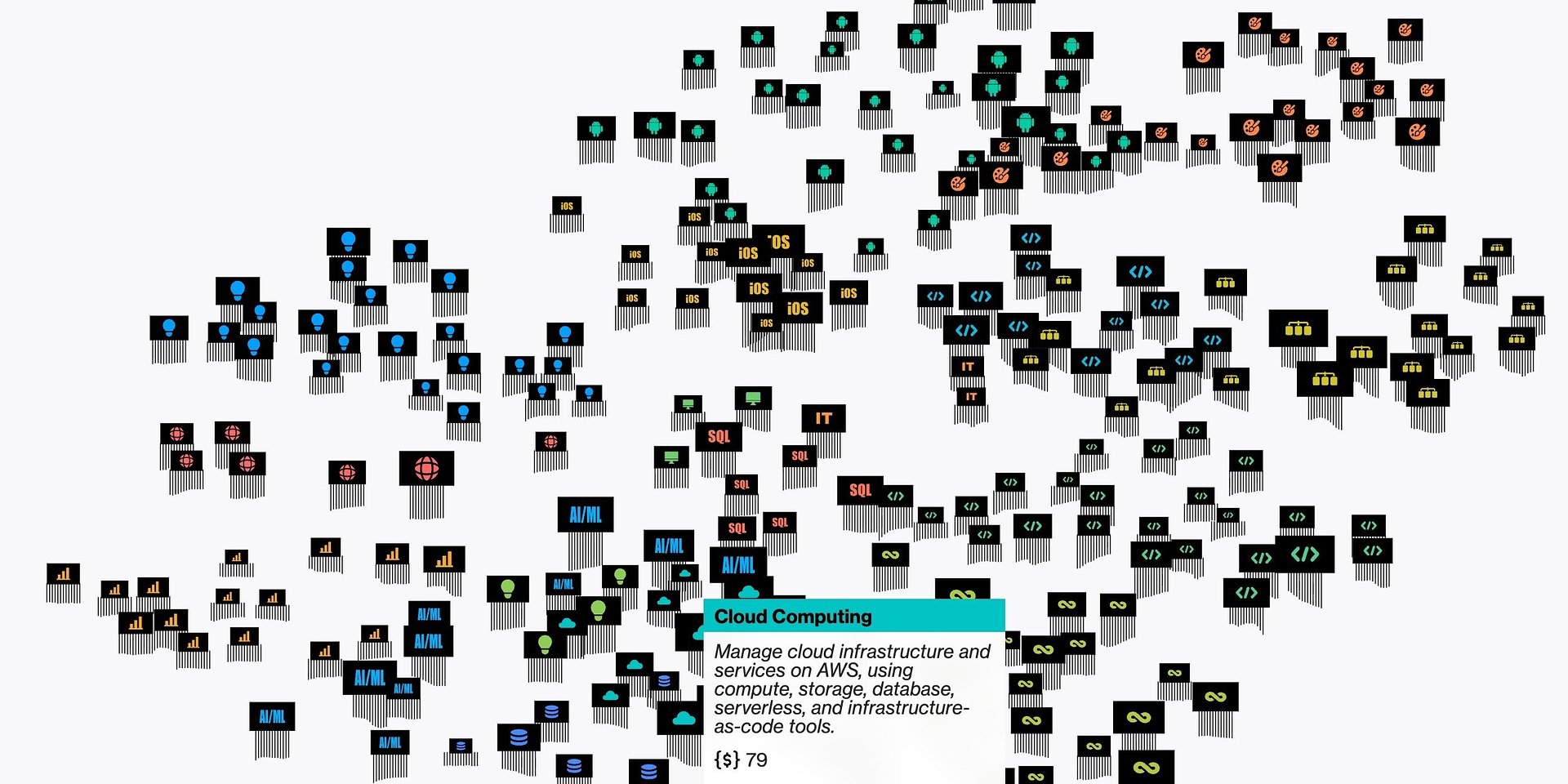
A visualization developed by researchers at the Complexity Science Hub (CSH) maps 237 software skills across nearly 1,000 cities, revealing where programming expertise is located and how it evolved over 13 years. European cities are falling behind the US and China but have important areas of strength to build on.
Software development is one of today’s leading industries – and it’s transforming fast. In recent years, the jobs needed to build and maintain software have further diversified. For example, cloud computing and expertise in artificial intelligence have emerged as highly sought-after skills.
“While we know where the biggest software firms are, it’s unclear where different kinds of software skills are located, because it is difficult to see how they build their products and what kind of expertise that requires,” says Frank Neffke, who leads the Transforming Economies research group at the Complexity Science Hub (CSH) and is also a professor at IT:U Interdisciplinary Transformation University Austria.
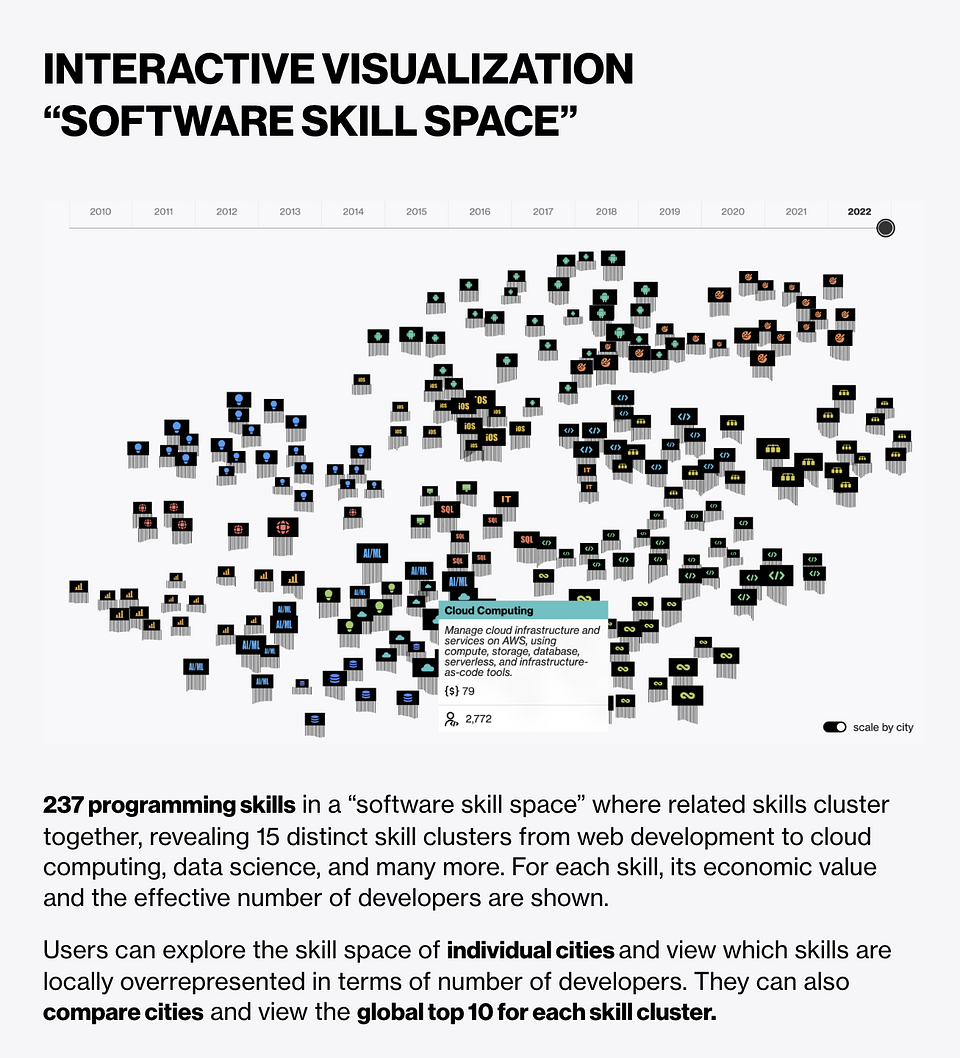
To shed light on this, Neffke, together with CSH faculty member Johannes Wachs and postdoc Xiangnan Feng, inferred software skills from the digital traces of millions of software workers in 976 cities between 2010 and 2022. Based on these data, and together with CSH data visualization expert Liuhuaying Yang, the team published an interactive visualization that lets users explore which software skills are available in cities across the world.
“Understanding this matters because software is one of the most economically valuable and geopolitically important industries,” says Neffke. “For a city that wants to grow its software sector, it is important to know what its current strengths in this sector are and what kind of diversification and growth paths these strengths enable for the future.”
Although the increasing use of AI is changing how software is made, the researchers argue that global patterns are still informative today. “While Large Language Models have transformed the way programmers work since 2022, the final year in our analysis, it takes years to become an experienced software developer. Therefore, what type of expertise a city specializes in changes only slowly. Although genAI certainly is transforming the sector fast, we expect that pre-genAI specialization patterns are still relevant for understanding what cities are good at now and in the immediate future,” states Neffke, whose research is supported by the netidee SCIENCE grant.
CITIES HAVE DISTINCT "SKILL SPECIALTIES" AND GROWTH POTENTIAL
The data reveal a pattern known from traditional industries: despite being a highly globalized “weightless” industry, software skills show strong geographical specializations. “For example, London is one of the biggest developer hubs overall, but some skills, such as AI- or iOS-related skills, are overrepresented in the British capital compared to other cities,” says Johannes Wachs, who is also an associate professor at Corvinus University of Budapest.
This is because workers tend to pick up skills adjacent to ones they already have. "Think about a place that starts out producing shirts," explains Wachs. "The local industry then diversifies into trousers, and later into sewing airplane seats. We see the same pattern in the software labor market ‒ which is surprising, given the industry isn't geographically constrained."
New software skills emerged in only a handful of places. Of 35 emerging skills studied, such as blockchain or deep learning, nearly two-thirds originated in just four cities: London, San Jose (Silicon Valley), New York, and Seattle. These new skills then preferentially spread to places that already had related skills.
“These findings not only highlight that places have specific strengths in the software industry, but also that the local potential for diversifying skills depends on the ones already present,” Wachs summarizes.
IN SOME (HIGH-PAYING) SKILLS, EUROPEAN CITIES ARE INTERNATIONALLY COMPETITIVE
“While European cities have overall fallen behind the US and China, many of them occupy pockets of global competitiveness they can build on, for example, by expanding into software skills adjacent to the ones present,” Wachs continues. The data show that several European cities are internationally competitive in economically important software skills. Dutch and Nordic cities rival global leaders in cloud computing; places in Germany and France with prestigious technical universities excel in data science, while Nordic and German regions dominate gaming technologies, and southern and post-2004 EU member states distinguish themselves in front-end development. Outside of the EU, London is still one of the world’s largest developer hubs.
The team also estimated the market values of each skill on a scale from 1 to 100. These rankings are based on what a skill would approximately pay on the US labor market. In this sense, iOS- and Android-related skills are the most valuable, along with AI-related skills and DevOps. Several Chinese cities have a particularly high concentration of these high-value skills – but also some European hubs such as Munich, London, and Paris, or technical university cities such as Karlsruhe.
RESOURCE FOR SETTING DEVELOPMENT GOALS
Since the skill space shows which software skills a city excels in compared to the global average, it could help local industries and policymakers assess a place’s position in specific segments of the software job market and set realistic development goals and policies.
While the visualization does not show data at the country-level, the skill space suggests that Austria has growth potential in Android-related skills, especially in Linz and Vienna, according to Neffke.
“To stay internationally competitive, the policy challenge for Europe is two-fold,” states the transformation researcher. “First, Europe needs to close the gap to the US and China in fast-growing software skills. And second, existing European strengths are fragmented across smaller hubs, each of which excels at different areas in software development, instead of concentrating them in a few large, broad-based hubs. Leveraging this distributed expertise is a challenge in its own right.”
DIGITAL TRACES REVEAL SKILLS OF MILLIONS OF PROGRAMMERS
The software skill space’s underlying data stems from questions, answers, and other user traces on Stack Overflow, an online Q&A platform where programmers can receive advice from peers. The team aggregated the data to the city level by using location data from the user profiles. This allowed them to compare skillsets across places and determine which ones are over- or underrepresented in a given city compared to the global average.
The skill space was validated against job ads, says Xiangnan Feng: “Our skill space predicts which bundles of skills companies ask for in job postings and how much those jobs pay. This suggests that the skill space captures the structures in the real-world labor market, not just skill structures unique to Stack Overflow users.”
SHIFTING SOFTWARE SKILLS IN THE AGE OF AI
Importantly, the method is not a full census of software workers but rather provides a window on the distribution of software skills based on Stack Overflow users. The team is currently working on obtaining a more comprehensive view by analyzing user data from GitHub, the leading developer platform for code management and sharing.
In recent years, Large Language Models have transformed how software developers work, “meaning that some skills we captured have changed dramatically since 2022, most notably within the machine learning/AI skill cluster,” says Neffke. “Next, using GitHub and other new data sources will allow us to keep monitoring how AI will shift the software labor market.”
About the research:
The visualization brings together findings from two related papers:
1. Xiangnan Feng, Johannes Wachs, Simone Daniotti, Frank Neffke. (2026). Using digital traces to analyze software work: skills, careers and programming languages (preprint)
2. Johannes Wachs, Xiangnan Feng, Simone Daniotti, Frank Neffke. (2026). The Changing Global Division of Labor in Software: Emergence and Diffusion of New Programming Skills across IT Hubs (preprint)
This visualization and research is supported by the netidee research project “Skills and the geography of software startups” (funded by FWF)
About the Complexity Science Hub (CSH)
The Complexity Science Hub (CSH) is Europe's research center for the study of complex systems. Drawing on large-scale data across economics, medicine, ecology, and the social sciences, CSH develops quantitative methods to understand the interconnected networks that underlie society – from financial markets and supply chains to public health and urban development. The goal is to provide a rigorous basis for navigating the challenges of an increasingly complex world.
Members of the Complexity Science Hub are: AIT Austrian Institute of Technology, BOKU University, Central European University (CEU), IT:U Interdisciplinary Transformation University Austria, Medical University Vienna, TU Wien, TU Graz, University for Continuing Education Krems, Vetmeduni, WU Vienna and WKO.
csh.ac.at